CONTEXT ➴
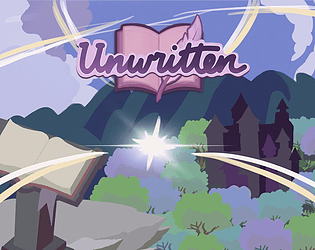
A fairytale has had its words stolen by villains trying to cover up their evil stories.
In Unwritten, the player is the book itself. To complete its story, it must explore the world, recover its missing words, and gain the abilities those words represent.
Our five-person team created the game in three weeks at Carnegie Mellon University’s National High School Game Academy. I worked as Producer and Sound Designer, shaping the experience across narrative, mechanics, feedback, and team execution.
THE CHALLENGE ➴
Fun was the goal—but “fun” could not be an excuse for disconnected ideas.
Games invite experimentation, spectacle, and playful mechanics. The harder design problem is deciding which ideas actually belong.
Interim feedback from CMU Entertainment Technology Center faculty challenged us to make Unwritten feel inseparable from its premise: create the story through gameplay, integrate the whole experience, and make sure it could not become any other RPG by simply replacing its sprites.
That critique gave us a clearer standard: every mechanic, interface, animation, and sound needed to strengthen what the player was learning, feeling, or choosing.
“Make it so it can’t be any other RPG.”
THE PIVOT ➴
Our inventory stored items. Our story was about stolen words. Why were they separate?
Our first inventory system worked like a familiar RPG menu: collect something, store it, and use it later. It was functional, but it could have belonged to almost any game.
Faculty feedback helped us recognize the missed opportunity. If the player was a book searching for its stolen language, then collecting a word should do more than fill a slot—it should literally rewrite the book.
Original item-based inventory
Story-driven word inventory
CORE SYSTEM ➴
The inventory became the story.
We redesigned progression around words. Each recovered word fills in part of the book’s missing story while also becoming a usable ability.
This connected three previously separate layers of the experience:
Narrative
Every collectible restores language the villains tried to erase.
Progression
New words mark the player’s movement through the world and reveal what happened.
Gameplay
The meaning of a word becomes an ability the player can use.
Inventory UI, collected words, and the story filling itself in
ONBOARDING ➴
Teach how the world works by letting the player complete its first sentence.
The opening library became a playable tutorial instead of a separate explanation screen.
The player first learns to move as the book. A book falls from a high shelf, leaving the word Smack on the ground. Collecting it teaches the central rule: words are both story and ability. The player then uses Smack against a spider and earns Venom, reinforcing the loop through action.
Rather than explain the system before play began, the sequence lets discovery, narrative, and instruction happen together.
PLAYTESTING ➴
A meaningful action still has to feel meaningful.
Playtesters understood the combat system, but described it as weightless. The mechanic existed logically; its feedback did not yet communicate force.
We treated sound, motion, color, and particles as usability—not decoration. A red overlay made damage immediately legible. Animation and impact sounds added force. Transparent attack particles reduced visual clutter, while movement, dust trails, and changing shadows gave the book more physical presence.
We also added details such as an open-book sound and an Escape-key interaction for the inventory, making the interface feel both more responsive and more natural to use.
Legibility
Color and overlays clarify when the player takes damage.
Impact
Sound, animation, and particles give attacks visible force.
Presence
Bobbing, dust, and responsive shadows make the book feel grounded.
MY ROLE ➴
Connecting the parts was as important as creating them.
As Producer, I helped the team translate a large creative vision into decisions we could complete within three weeks. The work required keeping narrative, art, code, combat, level design, and audio moving toward the same experience rather than becoming separate collections of ideas.
As Sound Designer, I used audio to clarify interactions and reinforce the world: attacks needed impact, the book needed presence, and opening the inventory needed to feel like opening part of the character itself.
The role taught me to look beyond whether an individual feature works and ask whether the entire system tells one coherent story.
Sprint board, team photo, production plan, or sound-design timeline
REFLECTIONS ➴
Game design made me a more intentional product designer.
Delight should have a job
A charming animation or satisfying sound can be beautiful, but its strongest form also communicates state, reinforces meaning, or guides the next action.
Mechanics are interaction models
Players build expectations from every response. Clear feedback, understandable rules, and meaningful consequences are as essential in a game as they are in any digital product.
A concept becomes memorable when every layer supports it
The word inventory succeeded because narrative, progression, interface, and gameplay stopped competing and began expressing the same central idea.
THE TAKEAWAY ➴
Every design decision should earn its place.
Unwritten taught me to evaluate ideas by more than novelty: What does this help someone understand? What does it invite them to do? How does it reinforce the experience around it? I still bring those questions into every product I design.
Three weeks, five amazing teammates, and one unforgettable summer at CMU’s NHSGA.